
German B1 Course in Delhi and Online
B1 is the level at which German stops being a subject and starts being a language you use. It needs 120 to 150 hours of class time on top of A2. B1 is the common minimum for an Ausbildung contract, and it is also the language level German law attaches to permanent residence and to citizenship, which makes it the most consequential level in the sequence for anyone planning to stay.
| Label | Value |
|---|---|
| Level | B1, independent user |
| Prerequisite | A2, or a placement test |
| Class hours | 120 to 150 hours |
| Duration | 1.5 months intensive, 3 months regular, longer on weekends |
| Exam prepared for | Goethe Zertifikat B1, telc Deutsch B1, or OeSD B1 |
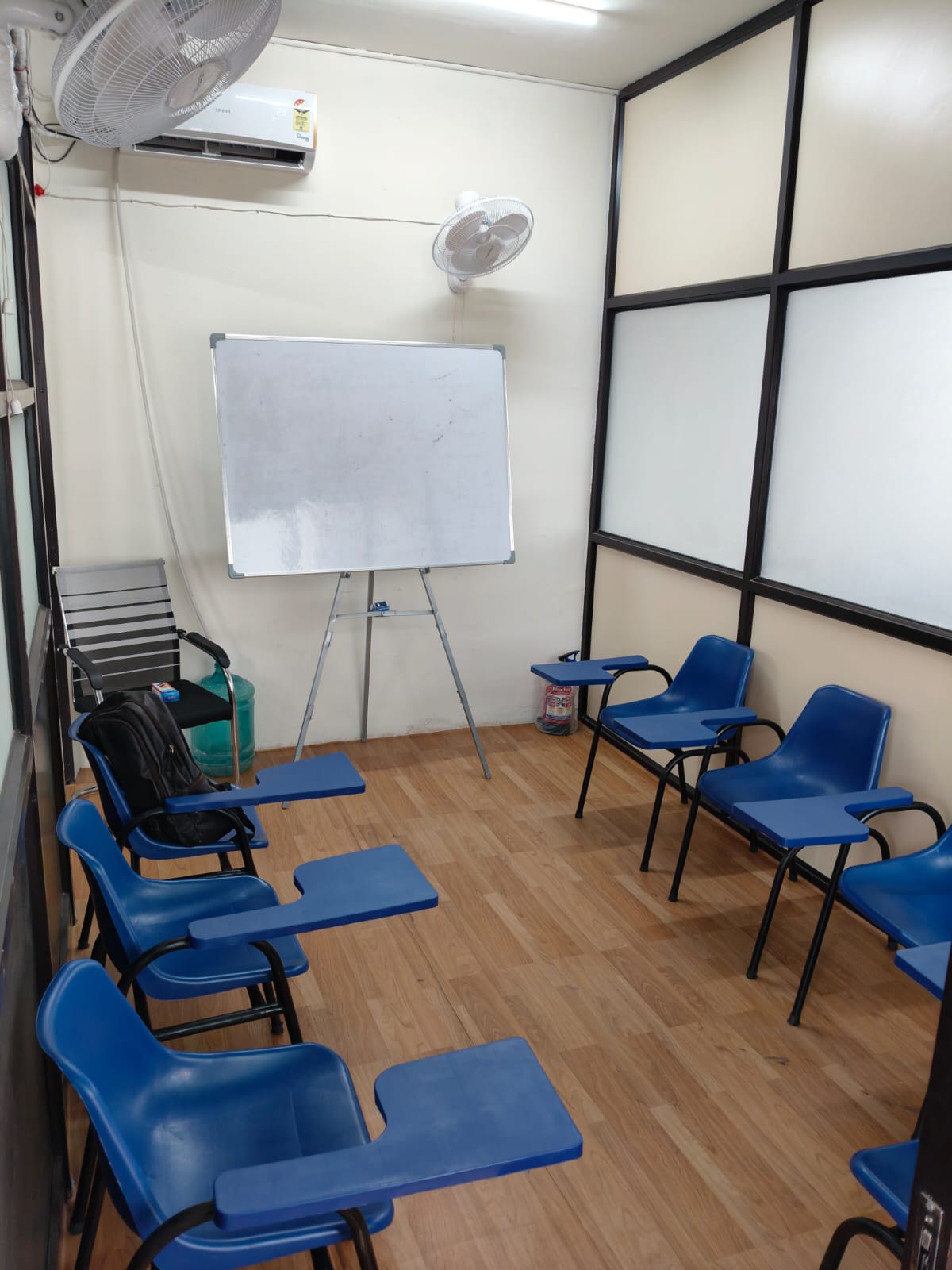
| Mode | Classroom in Rohini, or live online |
| Batch size | 7 to 10 students, capped |
| Course fee | Rs 18,000 standard, Rs 16,000 founding batch |
Who should take the B1 course?
Three groups, and they want different things from the same course.
Ausbildung applicants
B1 is the common minimum an employer will consider, and the level at which vocational school teaching becomes followable. Many employers now shortlist at B2, so treat B1 as the point where you become eligible rather than the point where you become competitive. For healthcare and elderly care Ausbildung, B2 is expected outright.
People planning to settle in Germany
This is the part most language institutes never mention. German law ties B1 to permanent residence and to naturalisation. Skilled workers can generally apply for permanent residence after three years with B1 and pension contributions, against five years otherwise, and EU Blue Card holders reach it in around twenty one months with B1 rather than the longer period without it. Since the 2024 change to citizenship law, naturalisation is possible after five years with B1 as the language requirement, and dual nationality is now permitted in most cases. Rules differ by state and by permit type, so confirm your own position with the responsible authority.
Nurses in transit
B1 lets you work as a nursing assistant in Germany, and it is the halfway point to the B2 you need for full recognition. It is not the destination, but it is the level at which you become employable rather than merely present.
What will you be able to do after B1?
B1 is defined as independence. You can deal with most situations that arise without needing someone to slow down for you.
- Handle almost any everyday situation while living, travelling or working in a German speaking country
- Hold a conversation on familiar topics and keep it going without long pauses
- Describe experiences, events, hopes and plans, and give reasons for your opinions
- Write connected text on subjects you know, including a formal complaint or a request
- Follow the main points of clear standard speech, including radio and simple work discussion
- Read straightforward factual text and understand the essential meaning
What B1 will not do. You will still lose the thread when two native speakers talk quickly to each other, and academic or clinical German is out of reach. B1 is not enough for nursing recognition, for a German taught degree, or for most patient facing and client facing work. It is enough to live and to be employed, which is a great deal, but it is not the finish line for a professional career.
What does the B1 syllabus cover?
Six modules. B1 is where the volume of grammar peaks, so the course is built to consolidate rather than only to introduce.
| Module | Theme | Grammar | You will be able to |
|---|---|---|---|
| 1 | Narrative and experience | Simple past, perfect tense in extended narrative, time expressions | Tell a story that holds together across paragraphs |
| 2 | Opinion and argument | Subordinate clauses, connectors, obwohl, deshalb, trotzdem | Give reasons, disagree politely, structure an argument |
| 3 | Work and the workplace | Passive voice, genitive case, formal register | Handle work conversation, write a formal email |
| 4 | Relations and description | Relative clauses, adjective declension in full, indirect questions | Describe people and things precisely |
| 5 | Hypothesis and politeness | Konjunktiv II, wishes, polite requests, conditional situations | Make polite requests, discuss what would happen if |
| 6 | Examination preparation | All four skills under timed conditions, including the paired speaking task | Sit a full mock examination with a partner |
The speaking part of the B1 examination is done with a partner rather than alone, which surprises candidates who prepared by themselves. We practise it in pairs from the first module so that the format is familiar long before the day.
Which certificate does B1 give you?
| Certificate | Awarded by | Notes |
|---|---|---|
| Goethe Zertifikat B1 | Goethe Institut, Max Mueller Bhavan in India | Most widely recognised. Can be taken and passed one module at a time |
| telc Deutsch B1 | telc GmbH | Widely accepted. Sensible if you are heading toward a telc B2 |
| OeSD Zertifikat B1 | Austrian Language Diploma | Recognised, less common in India |
One feature of the Goethe B1 examination is worth knowing before you book. It is offered in four modules, listening, reading, writing and speaking, and these can be taken and passed separately rather than all in one sitting. If you are strong in three skills and weak in one, you can secure the three and retake only the fourth. Confirm the current arrangement with the examination centre, since formats are revised from time to time.
Batch options, duration and fee
| Batch type | Days | Class length | Duration | Next start |
|---|---|---|---|---|
| Weekday regular | Monday to Friday | 2 hours a day | 3 months | Ask us for the date |
| Weekday fast track | Monday to Friday | 4 hours a day | 1.5 months | Ask us for the date |
| Weekend | Saturday and Sunday | 4 hours a day | CONFIRM | Ask us for the date |
| Live online | Monday to Friday | 1.5 hours a day | CONFIRM | Ask us for the date |
| One to one | On request | On request | On request | On request |
Build note on the arithmetic. Weekday regular and fast track both deliver about 130 hours, which sits neatly inside the stated 120 to 150. The weekend batch at four and a half to five months delivers about 165, which is above the range. Live online at one and a half hours a day over three months delivers about 98, which is a quarter below it. Both are held as CONFIRM until reconciled. See Section 6.
| Item | Standard | Founding batch |
|---|---|---|
| Course fee | Rs 18,000 | Rs 16,000 |
| Registration fee | Rs 1,800 | Rs 1,600 |
| Study material | Soft copies and notes, included | Included |
| Mock examinations | Included | Included |
| Examination fee | Paid directly to the examination body, not to us | Same |
| Instalments | Instalments and EMI available | Available |
The registration fee is ten percent of the course fee and is shown above as a rupee figure so you do not have to work it out. The examination fee is paid to the examination body directly and is separate from both. We put all of this on the page rather than at enrolment, because a fee nobody warned you about is the fastest way to lose a student’s trust.
Want the exact total for your batch? Book a free demo class and we will give you the full figure before you commit to anything, including registration, any instalment plan, and what the examination will cost you separately. No obligation to enrol after the demo.
Should you take B1 in the classroom or online?
At B1 the honest case leans toward the classroom, and the reason is specific rather than general. The B1 speaking examination is done in pairs, not alone, and a classroom hands you a rotating set of partners to practise with every week. Online gives you a partner too, but only from your own batch, and pairing depends on who shows up that day.
None of this rules out online. If you attend consistently and the trainer actively pairs students for speaking practice, live online works well at B1. Same trainer, same batch, same schedule either way. If you are working, outside Delhi, or your week moves around, online you attend beats classroom you skip.

What comes after B1?
| Your goal | Where you stop | Still to go after B1 |
|---|---|---|
| Ausbildung, general | B1 or B2 | None, or one |
| Ausbildung, healthcare | B2 | One |
| Nursing recognition | B2 | One |
| Permanent residence or citizenship | B1 | None |
| Skilled work in Germany | B1 or B2 | None, or one |
| German taught Masters | C1 | Two |
| German language job in India | B1 or B2 | None, or one |
Not sure whether B1 or B2 is your target?
It depends on your pathway rather than your ability, and the honest answer is often B2. Tell us where you want to end up and we will tell you where to stop, including if that means recommending one level rather than two.
Frequently asked questions
How long does the German B1 course take?
B1 needs 120 to 150 hours of class time on top of A2. Our fast track batch runs four hours a day and finishes in about six weeks, and the regular weekday batch runs two hours a day over three months. B1 rewards consistency more than intensity, so a steady batch you attend beats a fast one you miss.
What is the fee for the B1 German course in Delhi?
The B1 course fee is Rs 18,000, currently Rs 16,000 for our founding batch. Registration is ten percent on top, so Rs 1,800 and Rs 1,600. Study material and mock examinations are included and instalments are available. The examination fee is separate and paid to the examination body directly.
Is B1 enough for an Ausbildung in Germany?
B1 is the common minimum and it makes you eligible for most general Ausbildung positions. It does not make you competitive, because many employers now shortlist at B2, and healthcare and elderly care positions expect B2 outright. Treat B1 as the door opening rather than the offer arriving.
Is B1 enough for permanent residence in Germany?
B1 is the language level German law generally attaches to permanent residence and to naturalisation, alongside residence duration, pension contributions and a knowledge test. Skilled workers and Blue Card holders can reach it considerably faster than the standard five years. Requirements differ by permit type and by state, so confirm your own case with the responsible authority.
Can I get a German visa without any language certificate?
For several visa types, yes. An EU Blue Card carries no German language requirement at all. The Opportunity Card accepts B2 English in place of A1 German. English taught study programmes usually need none for admission. Family reunion is one of the few routes where a certificate is required by law. Check which visa you are applying for before assuming you need German.
Does a course completion certificate count for a visa or an employer?
No. A letter from a language institute, including ours, is not a language qualification. What is recognised is an examination certificate from a body such as Goethe, telc or the Austrian OeSD. You have to sit and pass the examination, and declaring your own level is not accepted anywhere that matters.
How hard is the jump from A2 to B1?
It is the biggest jump in the sequence. A2 asks you to assemble sentences, B1 asks you to build connected argument, and the grammar load peaks here with subordinate clauses, passive voice and Konjunktiv II. Learners who found A1 and A2 comfortable are often surprised by B1. That is normal rather than a sign of a problem.
Can I take the B1 exam in parts?
The Goethe B1 examination is offered in four separate modules and they can be taken and passed individually rather than in one sitting, which means a weak skill can be retaken alone. Confirm the current arrangement with the examination centre when you book, because examination formats are revised periodically.