
German A1 Course in Delhi and Online
A1 is the first level of German and the starting point for everyone learning from zero. It takes roughly 80 to 100 hours of class time and prepares you for the Start Deutsch 1 certificate, which German missions accept as proof of language ability for the family reunion visa. For every other pathway, from Ausbildung to nursing, A1 is step one of several.
| Label | Value |
|---|---|
| Level | A1, beginner |
| Prerequisite | None. Start from zero |
| Class hours | 80 to 100 hours |
| Duration | 5 weeks on fast track, 2.5 months on a regular batch, longer on weekends |
| Exam prepared for | Start Deutsch 1, Goethe or telc |
| Mode | Classroom in Rohini, or live online |
| Batch size | 7 to 10 students, capped |
| Course fee | Rs 16,000 standard, Rs 14,000 founding batch |
Who should take the A1 course?
A1 is unusual among the six German levels, because for some people it is the finish line and for everyone else it is the first step. Which one you are changes how you should approach the course and when you should book the exam.
If A1 is your destination
Spouses applying to join a partner in Germany are usually required to show a recognised A1 certificate. The requirement comes from the German Residence Act and has applied to family reunion applicants since the end of 2022. If this is you, A1 is not a stepping stone. It is the qualification you need, and passing the examination is the whole point of the course. Important exemptions exist. If your partner holds an EU Blue Card, is self employed, or is a highly skilled worker, the A1 requirement may not apply to you. You may also be exempt if you hold a university degree with strong employment prospects in Germany. Exemptions are widely misunderstood, and applicants are sometimes refused because they assumed one applied. Check the current requirement with the German mission handling your application before you enrol anywhere.
If A1 is your first step
Everyone else is passing through. Ausbildung applicants need B1 or B2. Nurses need B2. A German taught Masters needs C1. If your goal is any of these, A1 matters because of what it sets up rather than what it certifies. Take it properly, because B1 assumes a grammatical foundation laid here, and the most common reason learners stall partway through B1 is that they rushed A1 and A2.
If you are simply curious
A1 is also a reasonable place to test whether German suits you before committing to a longer plan. It is the shortest and least expensive level, and by the end you will know honestly whether you want to continue. We would rather you find that out at A1 than at B1.
What will you be able to do after A1?
By the end of A1 you can handle simple, predictable situations in German, provided the other person speaks slowly and clearly. Specifically, you will be able to do the following.
- Introduce yourself and ask someone about themselves, their family, their work and where they live
- Order food and drink, shop, ask prices and handle money
- Ask for and follow simple directions, and manage buses, trains and tickets
- Tell the time, make and change simple appointments, and talk about your daily
- Fill in a form with your personal details
- Write a short message such as a note, a postcard or a simple email
- Understand slow, clear speech on familiar everyday topics
Being equally clear about what A1 does not give you. You will not be able to follow a normal conversation between two Germans speaking at natural speed, watch German television without subtitles, or work in a German speaking environment. Those come later. Anyone promising fluency at A1 is not being straight with you.
What does the A1 syllabus cover?
The course is built in six modules and follows the standard framework used by the Goethe and telc examinations, so nothing you learn is wasted when you sit the test.
| Module | Theme | Grammar | You will be able to |
|---|---|---|---|
| 1 | Getting started | Alphabet and pronunciation, present tense of regular verbs, personal pronouns, W questions and yes or no questions | Greet people, introduce yourself, spell your name, count |
| 2 | People and everyday life | Articles der, die and das, nominative case, negation with nicht and kein, plural forms | Talk about family, work and where you live |
| 3 | Food, shopping and numbers | Accusative case, irregular verbs, numbers and prices, modal verb moechten | Order in a cafe, shop, ask prices, handle money |
| 4 | Home and daily routine | Possessive articles, modal verbs koennen and muessen, separable verbs, word order | Describe your home, your routine and your day |
| 5 | Getting around and time | Prepositions of place and time, imperative, dative with prepositions, telling the time | Ask directions, use transport, make appointments |
| 6 | Exam preparation | Perfect tense introduction, consolidation of all four skills | Sit a full mock examination under timed conditions |
Every module includes speaking practice from the first week rather than only at the end. Speaking is the part most beginners avoid and the part the examination tests face to face, so we start it before you feel ready. That is deliberate.
Which certificate does A1 give you?
A course completion letter is not a qualification. What a German mission accepts is an examination certificate from a recognised body. At A1 level, three certificates are named on the German missions checklist for family reunion in India.
| Certificate | Awarded by | Notes |
|---|---|---|
| Start Deutsch 1 | Goethe Institut, known in India as Max Mueller Bhavan | The most widely accepted and the usual default |
| Start Deutsch 1 | telc GmbH | Named on the same official checklist |
| Grundstufe Deutsch 1 | ÖSD, the Austrian Language Diploma | Also named. Accepted at German missions in India |
The examination has four parts, listening, reading, writing and speaking, and the speaking part is conducted in a small group rather than alone. You need an overall pass across the paper rather than a pass in each section separately. Confirm the current format and pass mark on the examination body website before you book, because formats are revised from time to time.
Two timing points that catch people out. First, examination slots in India commonly have a waiting period of several weeks, so book your test date while you are still studying rather than after the course ends. Applicants routinely finish the course and then lose a month waiting for a seat. Second, German missions in India expect the certificate to be recent, generally not older than one year at the time of application, so taking the examination far in advance of your visa application can leave you sitting it twice.
We tell you when to book, help you register, and run timed mock examinations in the final module so that the real thing is not the first time you have done it under pressure.
Batch options, duration and fee
| Batch type | Days | Class length | Duration | Next start |
|---|---|---|---|---|
| Weekday regular | Monday to Friday | 2 hours a day | 2.5 months | 31 August 2026 |
| Weekday fast track | Monday to Friday | 4 hours a day | 5 weeks | 31 August 2026 |
| Weekend | Saturday and Sunday | 4 hours a day | 3 months | 5 September 2026 |
| Live online | Monday to Friday | 1.5 hours a day | 2.5 months | 24 August 2026 |
| One to one | On request | On request | On request | On request |
| Item | Standard | Founding batch |
|---|---|---|
| Course fee | Rs 16,000 | Rs 14,000 |
| Registration fee | Ask us. Confirmed on your demo call | Same |
| Study material | Soft copies and notes, included | Included |
| Mock examinations | Included | Included |
| Examination fee | Paid directly to the examination body, not to us | Paid directly to the examination body, not to us |
| Instalments | Instalments and EMI available | Available |
The examination fee is paid to the examination body directly and is separate from the course fee. We say this on the page rather than at enrolment, because a fee nobody warned you about is the fastest way to lose a student’s trust.
Want the exact total for your batch? Book a free demo class and we will give you the full figure before you commit to anything, including registration, any instalment plan, and what the examination will cost you separately. No obligation to enrol after the demo.
Should you take A1 in the classroom or online?
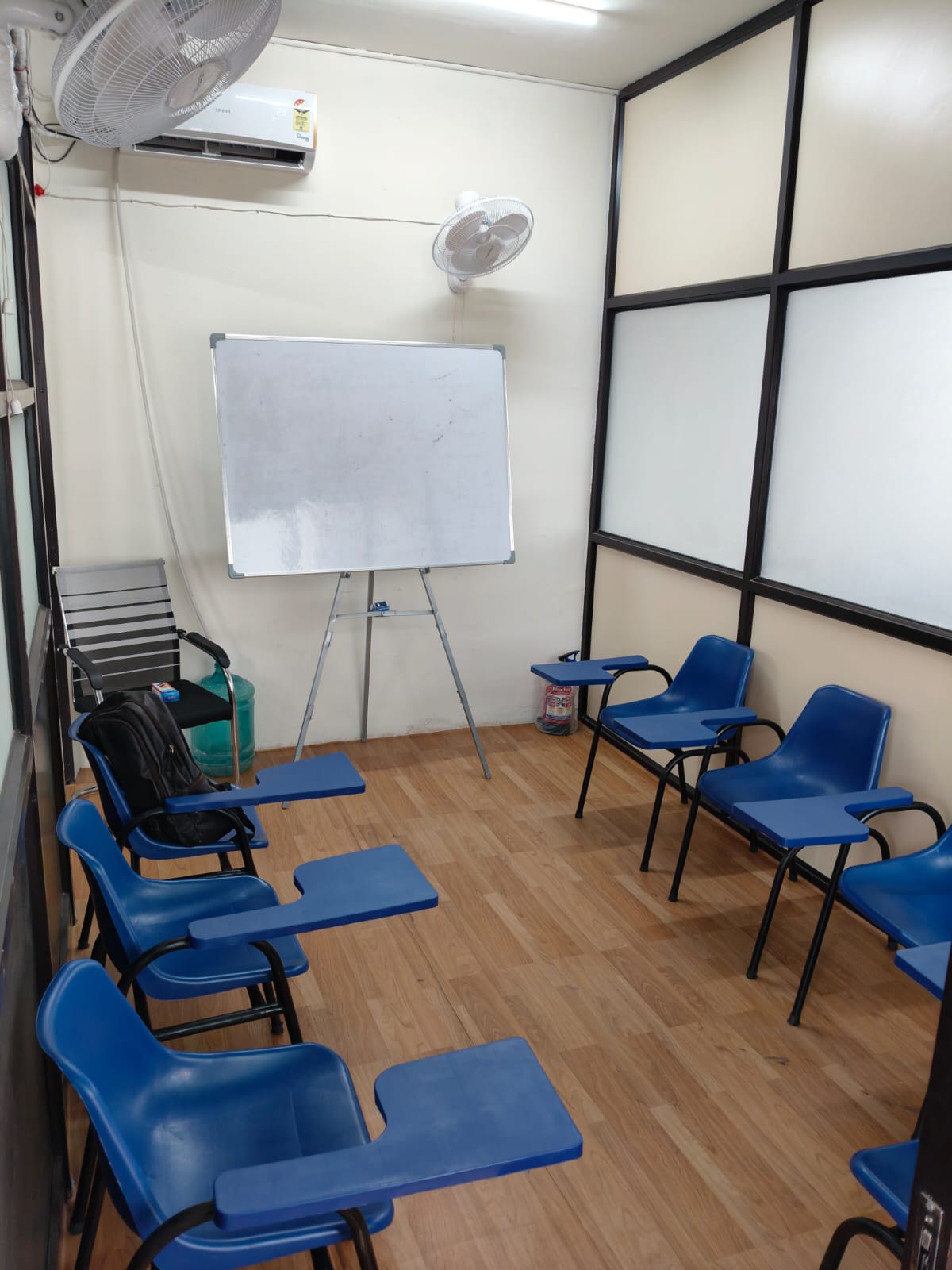
At A1 the honest answer leans slightly towards the classroom, and it is worth explaining why rather than pretending both are identical. Beginners have no vocabulary to fall back on, so pronunciation correction and the small unplanned exchanges around a physical class do more at this level than at any later one.
That said, live online works well at A1 if you attend consistently and speak up. It is not a recording. Same trainer, same batch, same schedule. If you are working, outside Delhi, or your week moves around, online you attend beats classroom you skip.

What comes after A1?
If A1 was your destination, nothing. You have the certificate your application needs. If A1 was your first step, A2 follows directly and most students move into the next batch without a break, because momentum matters more than people expect in language learning. A gap of a few months usually means repeating ground.
| Your goal | Where you stop | Levels still to go after A1 |
|---|---|---|
| Family reunion visa | A1 | None |
| Ausbildung, general | B1 or B2 | Two or three |
| Ausbildung, healthcare | B2 | Three |
| Nursing recognition | B2 | Three |
| Job in Germany | B1 or B2 | Two or three |
| German taught Masters | C1 | Four |
| German language job in India | B1 or B2 | Two or three |
Not sure if A1 is where you should start?
If you have never studied German, it is. Book a demo class and see whether the teaching suits you before you pay for anything. If you have studied German before, take a placement test instead, because starting below your level wastes your money and starting above it wastes your time.
Frequently asked questions
How long does the German A1 course take?
A1 needs 80 to 100 hours of class time. In calendar terms our fast track batch runs four hours a day and finishes in about five weeks, the regular weekday batch runs two hours a day over two and a half months, and live online runs an hour and a half a day over the same period. Add roughly the same again in self study.
What is the fee for the A1 German course in Delhi?
The A1 course fee is Rs 16,000, currently Rs 14,000 for our founding batch. Study material and mock examinations are included, and instalments and EMI are available. The examination fee is separate and paid to the examination body directly. Book a demo and we will confirm your exact total, including registration, before you commit.
Do I need any previous German to join A1?
No. A1 assumes you are starting from zero, including the alphabet and pronunciation. If you have studied German before, at school or elsewhere, take a placement test instead of assuming A1 is right. Starting below your level wastes money and starting above it wastes time.
Which certificate do I get after A1?
You sit an examination and earn a recognised certificate rather than a course letter. At A1 the options are Start Deutsch 1 from the Goethe Institut, Start Deutsch 1 from telc, or Grundstufe Deutsch 1 from the Austrian OeSD. All three are named on the German missions checklist for family reunion in India.
Is A1 enough for a German family reunion or spouse visa?
For most applicants, yes. A recognised A1 certificate is the language requirement for family reunion under German law. Exemptions exist, including where the partner holds an EU Blue Card or where the applicant holds a qualifying university degree. Confirm your own position with the German mission handling your application before you enrol.
Can I get a German visa without any language certificate?
For several visa types, yes. An EU Blue Card carries no German language requirement at all. The Opportunity Card accepts B2 English in place of A1 German. English taught study programmes usually need none for admission. Family reunion is one of the few routes where a certificate is required by law. Check which visa you are applying for before assuming you need German.
Does a course completion certificate count for the visa?
No. A letter from a language institute, including ours, is not a language qualification. German missions accept examination certificates from recognised bodies only, which at A1 means Start Deutsch 1 from Goethe or telc, or Grundstufe Deutsch 1 from the Austrian OeSD. You have to sit and pass the examination, and declaring your own level is not accepted.
When should I book the A1 examination?
While you are still studying, not after you finish. Test slots in India often have a waiting period of several weeks, and students routinely lose a month sitting idle. Also note that German missions generally expect the certificate to be less than a year old, so do not sit it far ahead of your visa application.
Is A1 enough to study or work in Germany?
No, and be careful of anyone who suggests otherwise. Ausbildung positions generally need B1 or B2. Nursing recognition needs B2. A German taught Masters needs C1. A1 is a genuine and useful qualification for family reunion, and for every other pathway it is the first of several levels.
Can I do A1 online?
Yes, in live online batches with the same trainer and schedule as the classroom. At beginner level the classroom has a slight edge, because pronunciation correction and informal practice matter most when you have no vocabulary to fall back on. If your schedule is unpredictable, online you attend is better than classroom you skip.
How many students are in a batch?
Between seven and ten, capped. Small batches matter more at A1 than at any later level, because the speaking examination is conducted face to face in a small group, and beginners need individual correction on pronunciation before the wrong habits set. A large beginner batch is the most common reason people plateau early.
What if I fail the A1 examination?
You can retake it, paying the examination fee again. This is one reason we run timed mock examinations in the final module rather than only teaching content. Most students who fail did not fail on knowledge, they failed on timing or on the speaking section, and both of those are fixable with practice.